Source mechanism of impulsive seafloor events that track submarine lava flows
Most of Earth’s volcanic eruptions are hidden beneath the ocean in complete darkness. Recent studies suggested that a type of impulsive event can track submarine lava flows, but their source mechanism remains uncertain. We analyze >20,000 impulsive events from the 2015 Axial Seamount eruption and find that their seismo-acoustic waveform characteristics suggest an implosive source mechanism. Integrating constraints from their spatiotemporal evolution with heat transfer estimates and geological observations, we propose that while the largest events might be related to volatiles degassed from magma, most events are generated by the implosion of bubbles formed from the vaporization of entrapped seawater by hot erupted lava. Similar events have been detected at other seamounts and slow to fast-spreading mid-ocean ridges, although eruptions at >3000-meter depth have proportionately fewer events because seawater vaporization is inhibited. Therefore, these impulsive seafloor events can be leveraged to remotely characterize eruption dynamics in most submarine volcanic settings.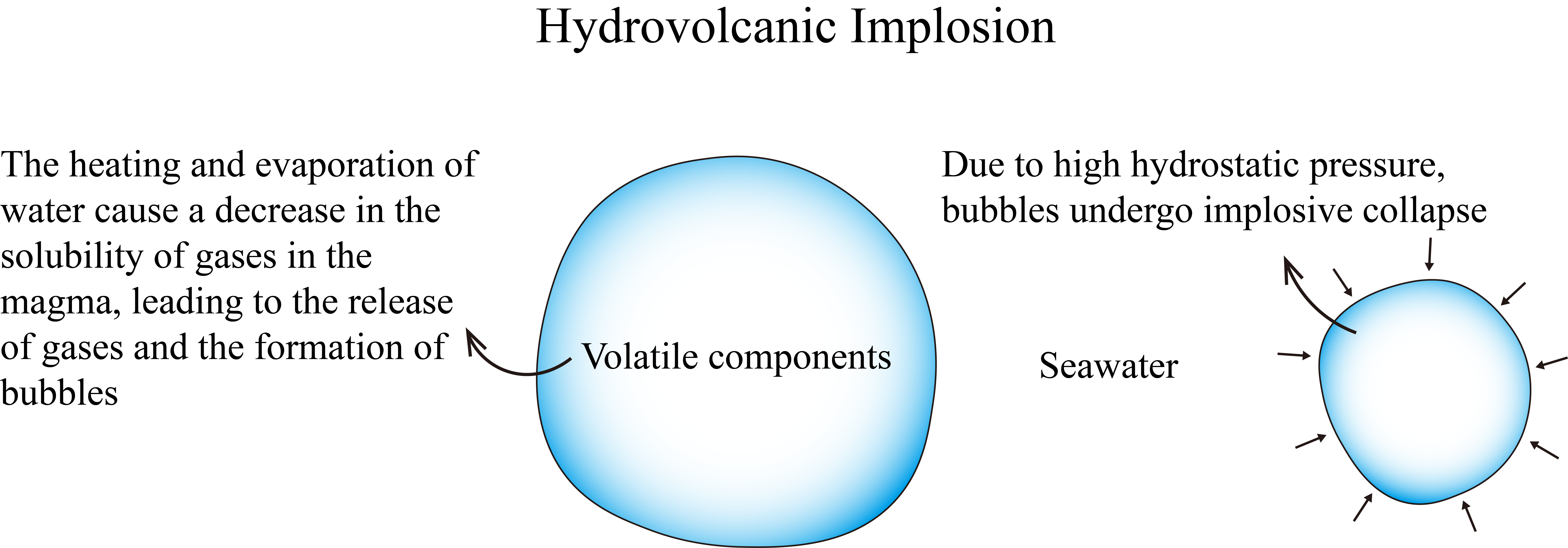
Investigation of Effects of Near-Surface Complexities on Measurement of Mantle Discontinuity Using SS and Its Precursors
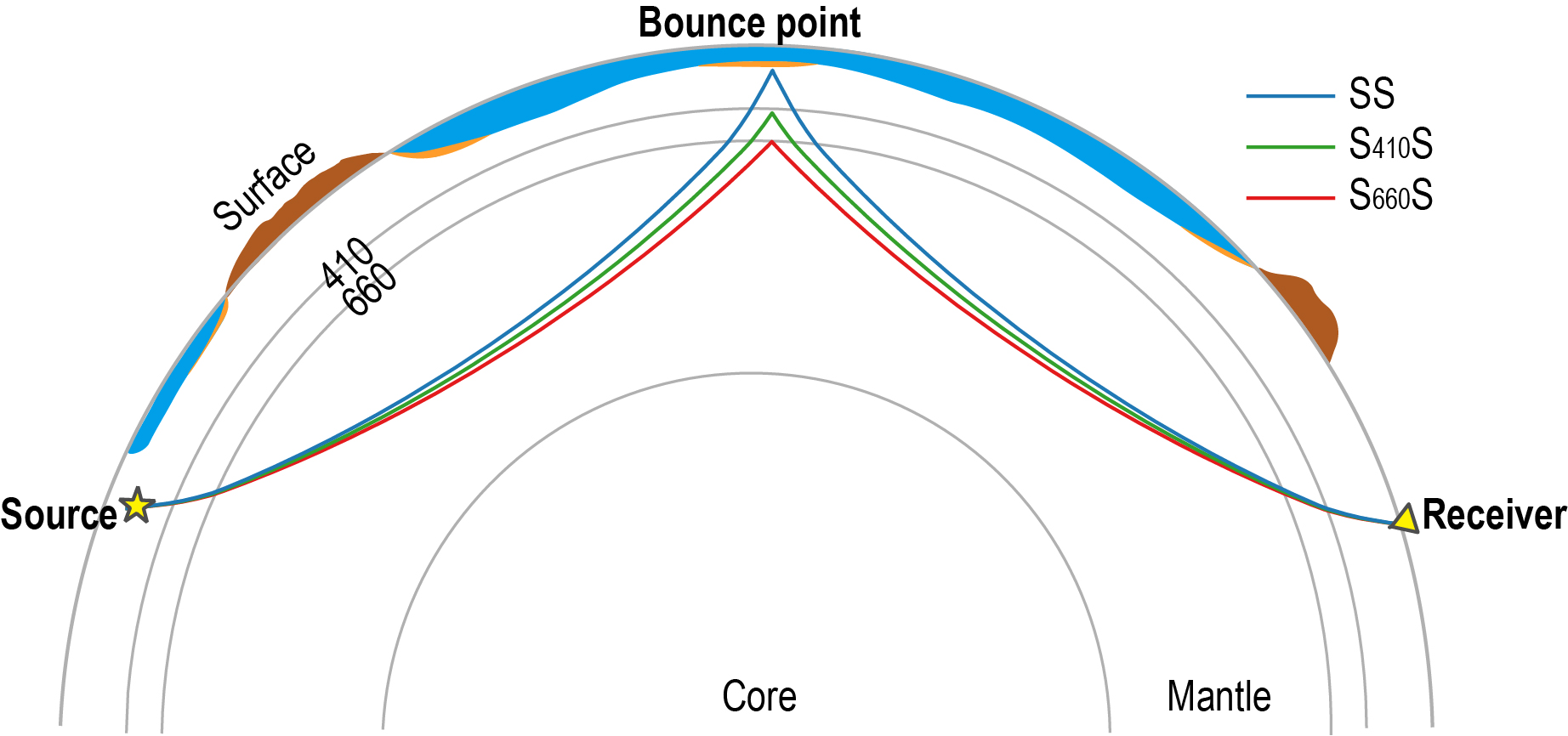
Seismic observations of the mantle discontinuities at depths of 410 and 660 km provide crucial information to constrain the thermal and compositional states and further shape our understanding of mantle dynamics. The topography and impedance contrast of the mantle discontinuities, at both global and regional scales, have been imaged through differential travel times and amplitude ratios between SS and its precursors. However, a relatively simple reference phase (SS) is often assumed, which may overlook potential bias caused by near-surface complexities. To assess these effects, we developed an algorithm to simulate the waveforms of SS and its precursors efficiently based on the propagation matrix method. We found that the crustal thickening increases the differential travel times but does not change the amplitude ratios much, while the sedimentary layer significantly affects both the differential travel times and amplitude ratios. The global anomalies of differential travel times and amplitude ratios are mapped incorporating earth models from CRUST1.0 and PREM. The time shift can reach ∼9 s, which will bring a depth bias of mantle discontinuity of more than 20 km, while the amplitude ratio anomaly is up to ∼40%, which will make the impedance contrast of the mantle discontinuity overestimated. The near-surface complexities cannot be ignored in the investigation of mantle discontinuities with SS precursors, especially when the bounce points located in the regions with sediment.